
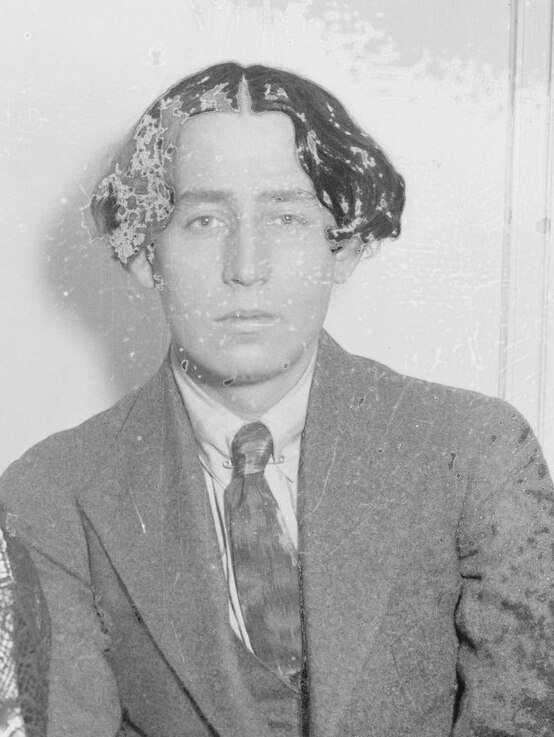
Dane Rudhyar
Pioneer of humanistic and transpersonal astrology.

Wikipedia / Wikimedia Commons
Dane Rudhyar (March 23, 1895 – September 13, 1985) was an American author, modernist composer, painter, and humanistic astrologer. He is recognized as a pioneer of modern transpersonal astrology and a key figure in the New Age movement.
Born Daniel Chennevière in Paris, Rudhyar was disabled at age twelve by a severe illness and surgery, leading him to focus on music and intellectual pursuits. He graduated from the Sorbonne at sixteen and also studied at the Paris Conservatoire. Early exposure to philosophy and Paris’s artistic community convinced him that existence is cyclical. Influenced by Nietzsche, he saw himself as a “seed man” for a new age of cultural evolution.
In November 1916, his music brought him to New York City. On April 4, 1917, the Metropolitan Opera performed his orchestral arrangements and original compositions as part of *Métachorie*, one of the first polytonal pieces heard in the United States. There he met Sasaki Roshi, an early Japanese Zen teacher in America, and began studying Oriental philosophy and occultism. Between 1917 and 1919, living in New York, Canada, and Philadelphia, he adopted the name “Rudhyar,” a cognate of Sanskrit words including the god Rudra. In 1920, after being asked to compose music for a production at the Theosophical Society’s Los Angeles headquarters, he deepened his involvement with Theosophy. He became a U.S. citizen in 1926. During the 1920s he split time between California and New York, and in 1930 married Marla Contento, secretary to independent Theosophist Will Levington Comfort. Comfort introduced him to Marc Edmund Jones, who provided mimeographed astrology lessons.
While learning astrology, Rudhyar studied Carl Jung’s psychological writings and began merging astrology with Jungian depth psychology. He also cited Jan Smuts’ *Holism and Evolution* as an influence. This synthesis addressed astrology’s deterministic tendencies and the problem of identifying a causal agent for astrological effects. Rudhyar argued that stars do not cause events but are synchronistically aligned with human beings, depicting psychological forces without overriding free will. He first called this “harmonic astrology,” later renaming it “humanistic astrology,” which he presented in *The Astrology of Personality* (1936). Theosophist Alice A. Bailey, who coined the term “New Age,” encouraged his work and published the book thr
- born
- March 23, 1895, Paris, France
- died
- September 13, 1985, San Francisco, California
- field
- Astrology, music composition, painting, writing
- nationality
- American (naturalized 1926)
- known_for
- Humanistic and transpersonal astrology; The Astrology of Personality (1936); modernist piano compositions
Lore & Background
Dane Rudhyar was born Daniel Chennevière in Paris. At age 12, a severe illness and surgery disabled him, leading him to focus on music and intellectual development. He studied at the Sorbonne and the Paris Conservatoire, graduating at 16. Influenced by Nietzsche, he saw himself as a 'seed man' of new age cultural evolution. In November 1916, his music brought him to New York City, and on April 4, 1917, his compositions were performed at the Metropolitan Opera in one of the first polytonal pieces in the United States. He adopted the name 'Rudhyar' between 1917 and 1919, inspired by Sanskrit words including the god Rudra.
Rudhyar's interest in Theosophy began in 1920 when he composed music for a production at the society's headquarters in Los Angeles. He became a U.S. citizen in 1926. In 1930 he married Marla Contento, secretary to Will Levington Comfort, who introduced him to Marc Edmund Jones, from whom Rudhyar received mimeographed astrology lessons. Rudhyar combined astrology with Carl Jung's psychology and Jan Smuts' Holism and Evolution, arguing that stars do not cause events but are synchronistic pictures of psychological forces. He called this 'humanistic astrology,' detailed in The Astrology of Personality (1936).
After divorcing in 1945, he married dancer Eya Fechin, daughter of painter Nicolai Fechin, and began larger-scale paintings. They lived in several states before divorcing in 1953. In the 1970s, as the New Age movement emerged, major publishers began issuing his works. He founded the International Committee for Humanistic Astrology in 1969 and later developed 'transpersonal astrology.' He died in San Francisco on September 13, 1985.
Reader's Guide
Dane Rudhyar's significance lies in his transformation of astrology from a deterministic predictive system into a tool for psychological insight and personal growth. By integrating Jungian depth psychology and the concept of synchronicity, he created humanistic astrology, which emphasized free will and the individual's response to planetary patterns. His 1936 book The Astrology of Personality became a foundational text for 'free-will' astrology and influenced the New Age movement of the 1960s and 1970s, particularly among San Francisco hippies. He later coined 'transpersonal astrology,' focusing on altered states and planetary consciousness.
Beyond astrology, Rudhyar was a modernist composer whose dissonant, non-systematic music influenced early-20th-century composers such as Ruth Crawford and Carl Ruggles, and was later rediscovered by composers like James Tenney and Peter Garland. He also contributed to transcendental painting, joining the Transcendental Painting Group in 1938–1939, and wrote novels and philosophical works. His legacy endures as a multidisciplinary thinker who bridged art, music, psychology, and spirituality, and his prediction that the Age of Aquarius would begin in 2062 remains a notable cultural reference.
Did You Know?
- Rudhyar's music was performed at the New York Metropolitan Opera on April 4, 1917, as one of the first polytonal pieces in the United States.
- He adopted the name 'Rudhyar' from Sanskrit words including the name of the god Rudra.
- Rudhyar predicted in 1972 that the Age of Aquarius would begin in 2062.
- He joined the Transcendental Painting Group in Santa Fe, New Mexico in 1938 and 1939.
Gallery
More in Fringe Figures And Pseudoscience 1-24
Spotted an error? Know more?
This is a living reference — every entry is fact-audited, and reader corrections feed straight into our audit queue. Suggest an edit · See this site's audit record